
For O&P clinics, the appeal of in-house 3D printing is clear: faster production, lower fabrication costs and greater control over when devices are made.
But purchasing a printer does not automatically create a reliable digital fabrication workflow. The more important question is what happens after the equipment arrives — and how much of the process your team must manage itself.
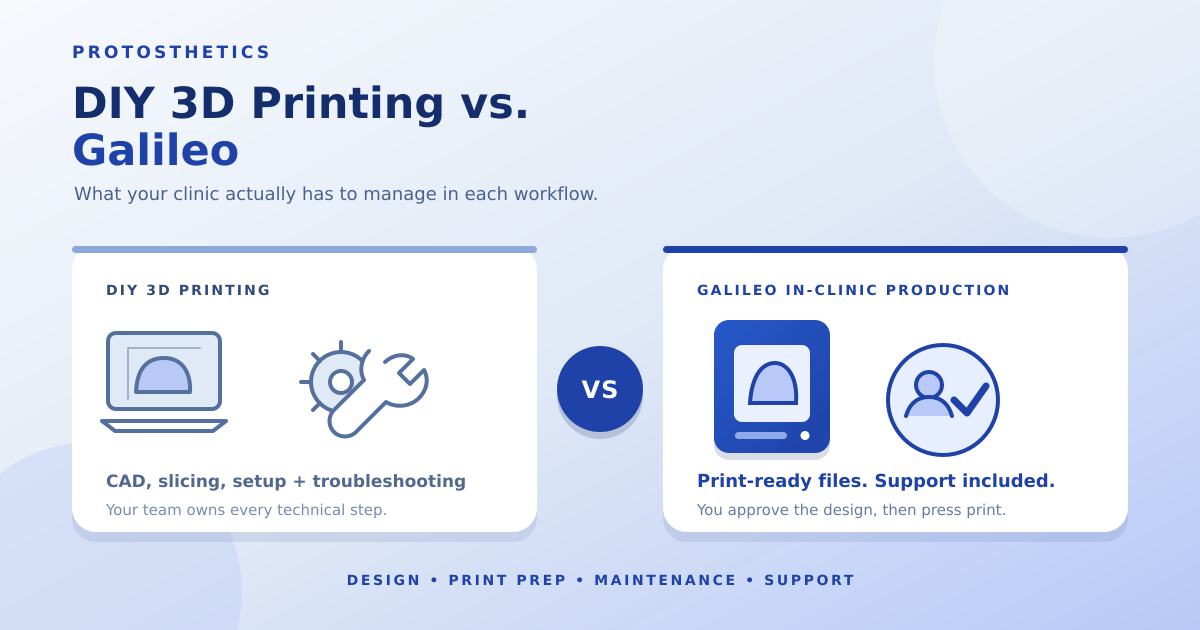
In a DIY workflow, the clinic owns nearly every step between capturing patient anatomy and fitting the finished device.
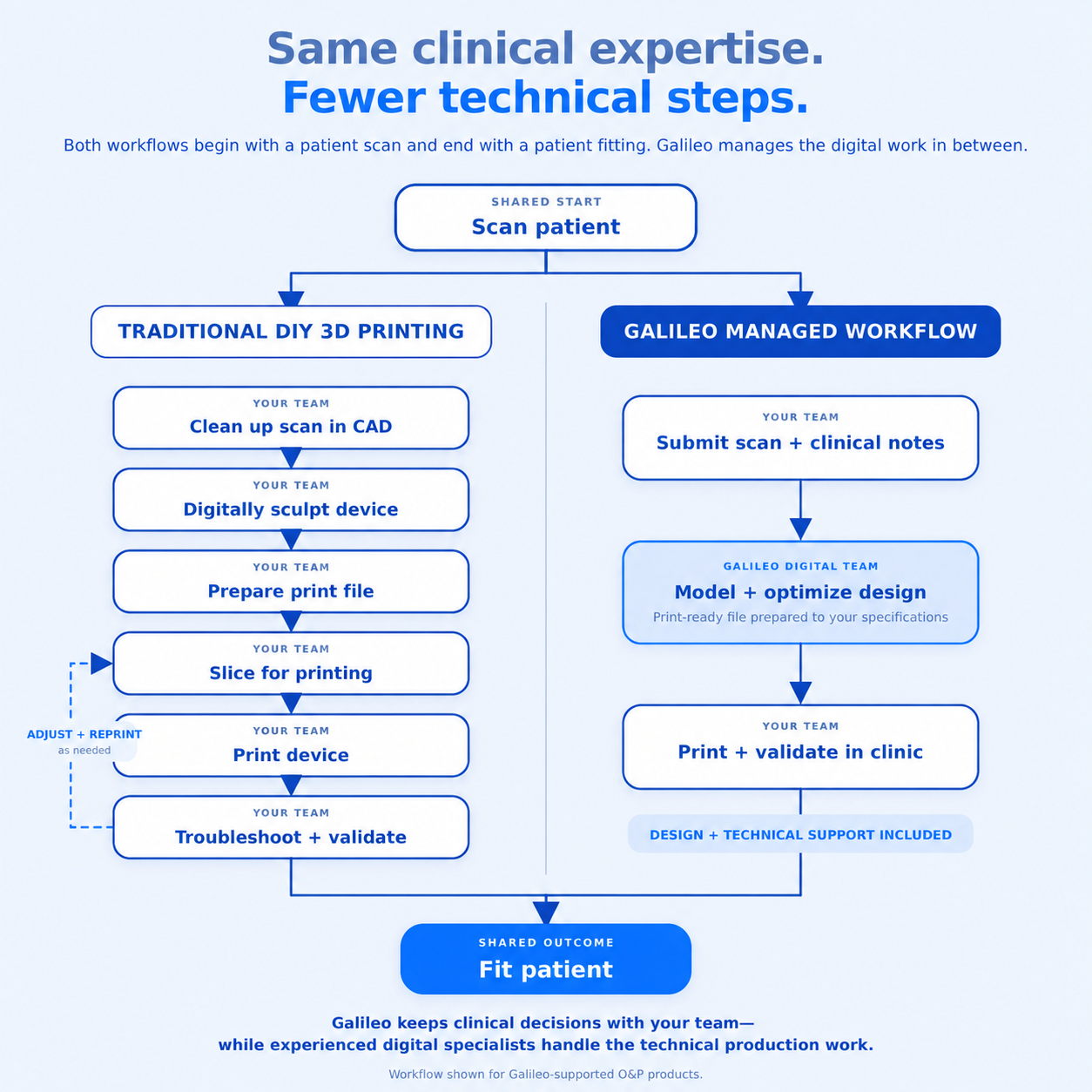
After scanning the patient, someone must modify the scan, digitally sculpt the device, prepare and slice the file, configure the print and troubleshoot problems. Once the device is printed, the clinic must complete the necessary finishing, validate the result and make any adjustments before fitting the patient.
If a print fails or the design changes, those technical steps begin again.
DIY printing can work for clinics with experienced digital-design staff and the capacity to manage additive manufacturing. For many busy O&P practices, however, it creates a second job behind the printer.
Galileo keeps production inside the clinic while shifting much of the technical design work to an experienced digital team.
Your clinician scans the patient and submits the order with clinical notes and specifications. Galileo’s digital technicians, led by your Digital Lead, model the device and optimize it for production. Your team can review and approve the design through the FabOne print management portal, and the completed file arrives ready to print as-is.
Your clinic then starts the print, completes the appropriate post-print preparation and fitsthe device. Production remains in-house, but clinicians and technicians are not responsible for every CAD and file-preparation step required to get there.
Using digital-design support does not mean giving up control.
The clinician still determines the clinical requirements, communicates design preferences, provides feedback and approves the outcome. Galileo’s role is to translate that direction into a consistent, print-ready design.
Galileo also supports the systems surrounding the printer. Clinical and fabrication staff receive training, while remote support is available for hardware and software troubleshooting – if ever needed. The program includes hardware warranty and replacement support, with substitute CFAB production available during qualifying printer downtime.
That gives clinics a clear path forward when something goes wrong instead of leaving their team to diagnose every issue alone.
Bringing 3D printing in-house usually comes with a catch: a massive upfront equipment bill before you even print your first device. Galileo breaks down those barriers – starting with the price tag.
Instead of requiring a massive $25,000+ upfront investment just to get your first print off the bed, Galileo reimagines equipment ownership through a seamless lease-to-own model. You sidestep the traditional capital expense entirely, building full ownership of your 3D printer simply by using the system.
Successful O&P practices thrive by balancing exceptional patient care with smart cost control. With Galileo, your clinic gains access to cutting-edge fabrication technology—without draining your cash reserves.
DIY 3D printing may fit clinics with:
For most O&P practices, Galileo offers a more practical path:
Galileo combines in-clinic production with the expertise and support needed to make it work.
Talk to a Galileo Specialist to see how the workflow could fit your team, device volume and fabrication goals.


.png)

.jpg)




.jpeg)
.png)

.png)